The smallest countries in the world· by land area
The smallest country in the world is Vatican City, at about ~0.44 km² — roughly the size of a large city park, and a figure the World Bank does not publish. Among the sovereign states it does track, the smallest is Monaco at 2 km², followed by Nauru and Tuvalu. This page counts 194 of them.
Two honest choices shape this list. First, it defaults to sovereign states only, because "smallest country" means a country — not a dependent territory like Gibraltar or Macao, which are smaller still but belong to another state. A toggle adds those places back. Second, it ranks land area: the ground itself, with inland water and the sea left out. Vatican City sits above the ranking as a reference, not inside the World Bank data.
Where the smallest countries are
The deep color marks the smallest states, and most of them are hard to see at this scale — dots in the Mediterranean, the Caribbean and the Pacific. The map and the ranked list beside it move together. Hover or tap any country to read its land area.
Tap a country to read its figure.
Natural Earth 10m · Crimea shown as Ukraine · source: World Bank, CC BY 4.0
Every country, ranked from the smallest up
Sovereign states only, smallest first — 194 of them. Vatican City sits above the table as a reference, because the World Bank does not publish a figure for it. Click a column to sort.
| # ▲ | Country | Land area | Population |
|---|---|---|---|
| 1 |  Monaco Monaco | 2 km² | 38,341 |
| 2 |  Nauru Nauru | 20 km² | 12,025 |
| 3 |  Tuvalu Tuvalu | 30 km² | 9,492 |
| 4 | 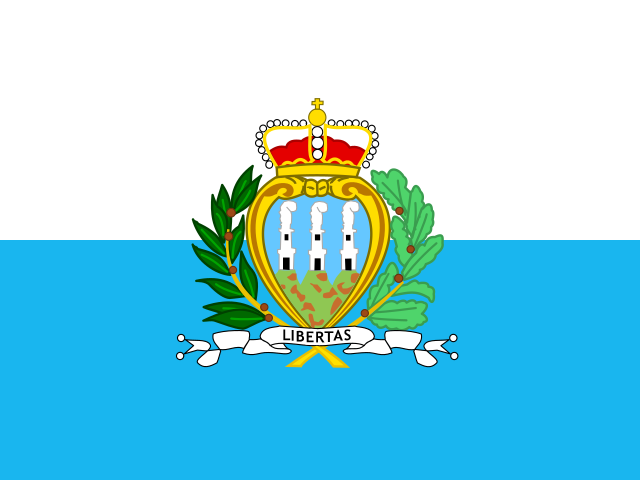 San Marino San Marino | 60 km² | 34,109 |
| 5 | 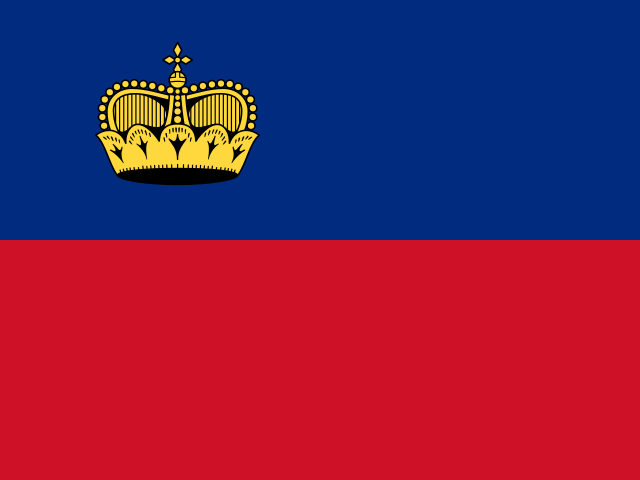 Liechtenstein Liechtenstein | 160 km² | 41,024 |
| 6 | 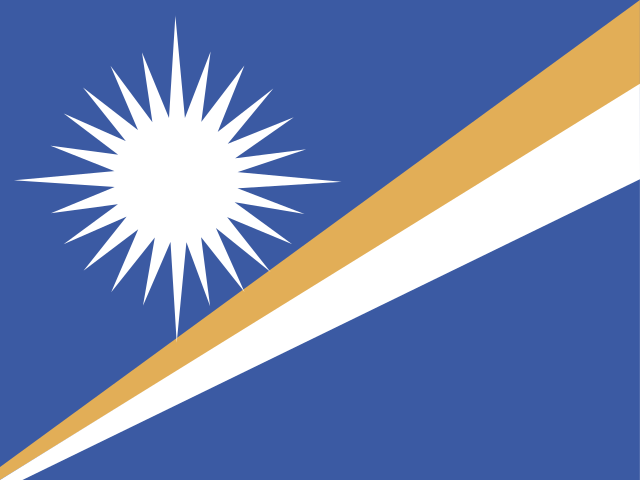 Marshall Islands Marshall Islands | 180 km² | 36,282 |
| 7 | 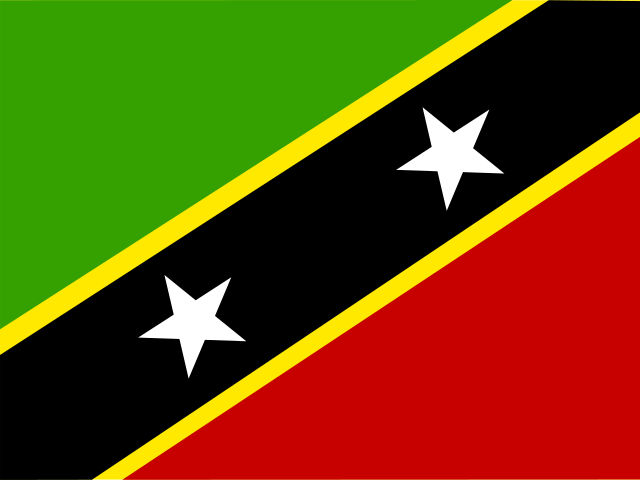 St. Kitts and Nevis St. Kitts and Nevis | 260 km² | 46,922 |
| 8 |  Maldives Maldives | 298 km² | 529,676 |
| 9 |  Malta Malta | 320 km² | 579,704 |
| 10 |  Grenada Grenada | 340 km² | 117,303 |
| 11 |  St. Vincent and the Grenadines St. Vincent and the Grenadines | 390 km² | 99,924 |
| 12 |  Barbados Barbados | 430 km² | 282,623 |
| 13 |  Antigua and Barbuda Antigua and Barbuda | 440 km² | 94,209 |
| 14 |  Seychelles Seychelles | 460 km² | 122,730 |
| 15 |  Palau Palau | 460 km² | 17,663 |
What "smallest" really measures here
This ranking uses land area — the ground inside a country's borders, in square kilometres, from the World Bank. By that measure the smallest sovereign state in its data is Monaco, about 2 km², roughly the footprint of a mid-sized airport. But the true smallest country is Vatican City, at around ~0.44 km² (44 hectares). The World Bank publishes no land-area figure for the Vatican, so we show it as a reference above the table rather than folding an outside number into the dataset.
The other choice is what counts as a country. The raw data mixes sovereign states with dependent territories — Gibraltar (a British territory), Macao (a Chinese special administrative region), Bermuda, Sint Maarten — several of which are smaller than the smallest sovereign state. Rank them all together and the "smallest country" turns out not to be a country at all. So this page defaults to sovereign states only, 194 of them, and offers a toggle to add the 22 territories back when you want the full picture.
One more caveat, the same one as on the largest-countries page: land area leaves out inland water and stops at the coast, so it runs a little below the "total area" quoted in almanacs. For a microstate the gap is tiny in absolute terms but can matter in a list this tightly packed. Very small states are also measured inconsistently across sources — a few square kilometres of rounding can swap two neighbours. Read the order near the top as close, not exact.
Five numbers worth remembering
The same dataset, squeezed into the facts people actually retell.
Where does a country stand?
Numbers land harder when one of them is a place you know.
Frequently asked questions
What is the smallest country in the world?
Vatican City is the smallest country in the world, at about ~0.44 km² (44 hectares) — a walled enclave inside Rome. It is a reference figure, since the World Bank does not publish a land-area series for the Vatican. Among the sovereign states the World Bank does measure, the smallest is Monaco, about 2 km², followed by Nauru and Tuvalu.
Is Monaco or Vatican City smaller?
Vatican City is smaller. It covers roughly ~0.44 km² against Monaco's 2 km² — Monaco is about four to five times the Vatican's size. Monaco tops this ranking only because it is the smallest state in the World Bank dataset, which does not include the Vatican; add the Vatican as a reference and it takes first place.
Is Vatican City really a country?
Yes, in practice. The Holy See is a sovereign entity that maintains diplomatic relations with most of the world and holds permanent observer status at the United Nations, alongside Palestine. It is not a full UN member, and the World Bank does not publish economic or land-area series for it, which is why it appears here as a reference above the ranked table rather than as a data row.
What are the smallest countries in the world?
After Vatican City, the smallest sovereign states by land area are Monaco (2 km²), Nauru (20 km²) and Tuvalu (30 km²), then San Marino, Liechtenstein, the Marshall Islands and Saint Kitts and Nevis. In all, 24 of the 194 states with a figure are under 1,000 km². These are World Bank land-area numbers for 2023.
Why are Gibraltar and Macao not in the main list?
Because they are not sovereign states. Gibraltar is a British overseas territory and Macao is a special administrative region of China; both are smaller than the smallest sovereign state, so ranking them together would make the "smallest country" not a country at all. This page defaults to sovereign states only. Switch the toggle to "All places" and 22 dependent territories join the list — the smallest of them being Gibraltar, at 10 km².
What counts as land area versus total area?
Land area is the dry ground inside a country's borders; total area adds inland water — lakes, reservoirs, major rivers — and sometimes coastal waters. This page uses the World Bank's land-area figure, so numbers here run a little below the "total area" quoted elsewhere. For the smallest states the difference is a fraction of a square kilometre, but in a list this tightly packed even that can nudge the order, so read the top few as very close (Monaco at 2 km², for instance).
Sources & further reading
The ranking is built on the World Bank's Land area, sq. km (AG.LND.TOTL.K2), under CC BY 4.0. Sovereignty follows UN membership; Vatican City is a reference figure from published records, not the World Bank.